

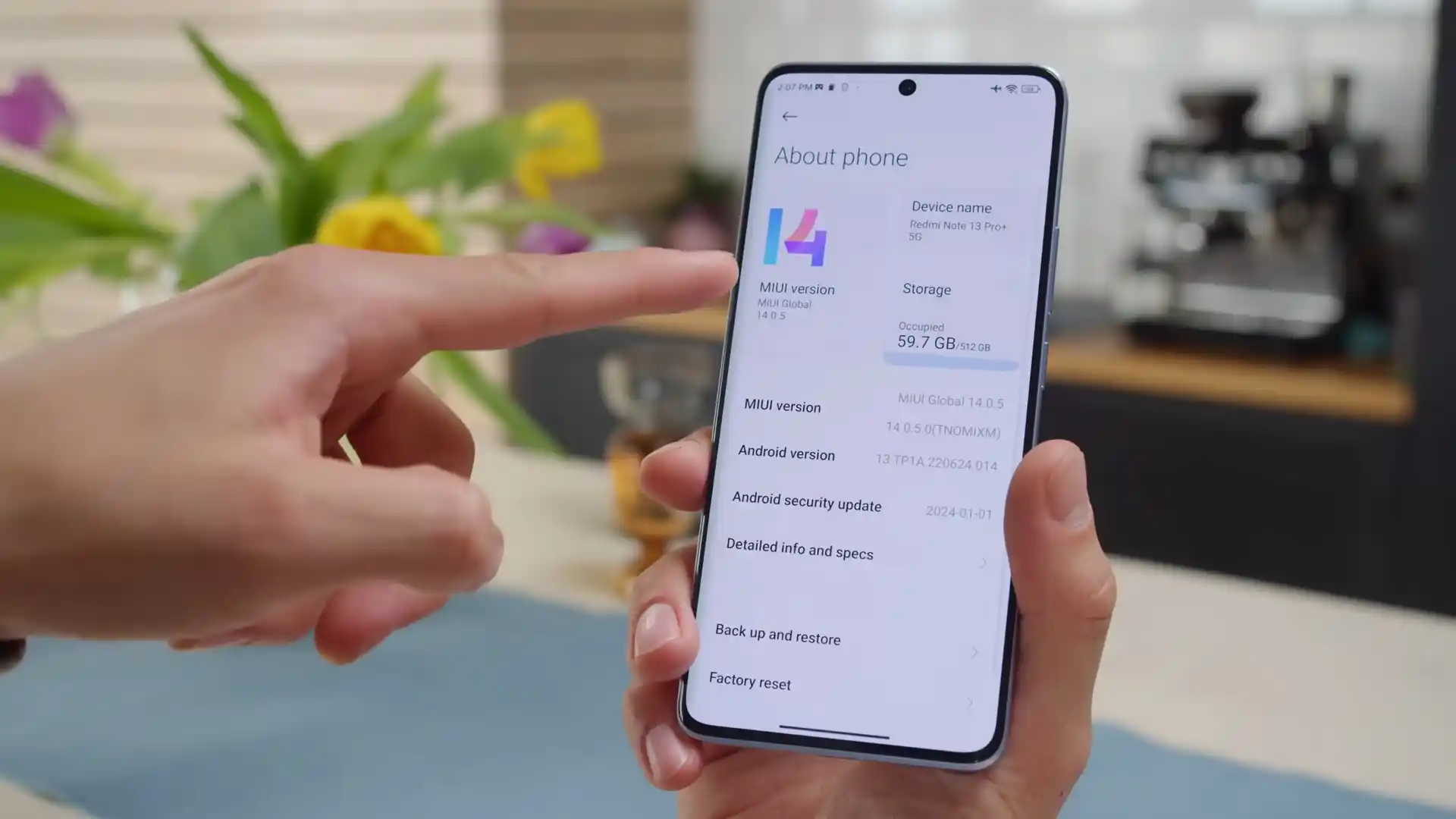
Before you flash: Flashing firmware will erase all data on your device. Back up contacts, photos, and apps before proceeding. FlashGuideHub is not responsible for any damage caused by following this guide.
About the Xiaomi Redmi Note 13 Pro+ 5G
This workshop guide provides step-by-step bench instructions to flash official stock Fastboot firmware to the Xiaomi Redmi Note 13 Pro+ 5G (September 2023) using Mi Flash Tool. Writing multi-gigabyte system and dynamic super partitions to MediaTek's MediaTek Dimensity 7200-Ultra (4nm TSMC) platform over high-speed UFS 3.1 storage requires stable USB driver handshakes and correct batch script selection.
Whether your phone is trapped in a startup bootloop, fixing system bugs after an update, or returning to clean official HyperOS 3.0 (Android 16.0), follow the verified prerequisites, battery precautions, and step-by-step flashing procedures detailed below.
Which Flash Mode Should You Use?
Xiaomi Mi Flash Fastboot Flashing (Recommended)
Standard official method for restoring stock HyperOS firmware using an unlocked bootloader and Mi Flash Tool in Fastboot mode.
MediaTek BROM Emergency Flash Mode
Emergency download mode accessed via motherboard test points to revive hard-bricked devices unable to enter Fastboot.
Recovery Sideload & Local Update
Official recovery interface used for installing signed recovery update packages directly over USB or on-device storage.
What You Need Before Flashing
Fastboot flashing requires an officially unlocked bootloader via the Xiaomi Mi Unlock utility.
A 64-bit Windows PC with MediaTek USB VCOM drivers and updated Android SDK Platform Tools installed.
Ensure the battery has at least 50% charge to prevent shutdown during 9GB+ sparse partition writes.
Use a certified USB Type-C data sync cable plugged directly into a rear motherboard USB port.
Flashing stock Fastboot firmware with "clean all" completely wipes internal storage and applications.
Decompress the .tgz archive twice using 7-Zip until flash_all.bat is exposed in a clean root directory.
How to Flash the Xiaomi Redmi Note 13 Pro+ 5G — Quick Overview
These 5 steps are tailored to the Xiaomi Redmi Note 13 Pro+ 5G (Dimensity 7200-Ultra). For screenshots, an interactive checklist, and troubleshooting, open the full Mi Flash Tool guide.
-
Unlock bootloader with Mi Unlock
-
Decompress Fastboot TGZ archive twice
-
Enter Fastboot mode
-
Configure Mi Flash Tool with "clean all"
-
Flash firmware and await first boot
Firmware Package for Dimensity 7200-Ultra (flash_all.bat)
Official Fastboot firmware packages for the Xiaomi Redmi Note 13 Pro+ 5G are distributed as multi-gigabyte .tgz archives containing raw partition binaries (boot.img, init_boot.img, vendor_boot.img, dtbo.img, vbmeta.img, and sparse super.img dynamic partitions) written via flash_all.bat and Fastboot protocols across the MediaTek Dimensity 7200-Ultra UFS 3.1 storage controller.
flash_all.bat
Official Xiaomi Redmi Note 13 Pro+ 5G firmware is distributed as multi-gigabyte .tgz archives. Extract the archive twice using 7-Zip until the folder containing "flash_all.bat" and the raw partition images is visible.
Fastboot Flashing Rule: Always select "clean all" (flash_all.bat) when using Mi Flash Tool on imported hardware to avoid triggering the "The system has been destroyed" bootloader lock brick.
Xiaomi Redmi Note 13 Pro+ 5G Firmware Versions
Official stock firmware downloads for the Xiaomi Redmi Note 13 Pro+ 5G. Verify your hardware model variant before downloading.
| Version | Region | Android Version | Size | MD5 | Download |
|---|---|---|---|---|---|
OS3.0.303.0.WNOEUXM (HyperOS 3.0) |
EEA (Europe / UK) | Android 16.0 | 9.0 GB | a797a762e0ecb383bc5ced70c554b0f3 |
⬇️ Download |
OS3.0.305.0.WNOCNXM (HyperOS 3.0) |
China (CN) | Android 16.0 | 8.5 GB | cf641c519fa7c011595310a079bc7139 |
⬇️ Download |
OS3.0.301.0.WNOINXM (HyperOS 3.0) |
India (IN) | Android 16.0 | 8.0 GB | b9ae4ee554baa4e1e004bacb3ab990c2 |
⬇️ Download |
This phone has 14 additional regional, recovery, and custom recovery builds. Browse the complete archive on AndroidFirmwareFile.com →
Xiaomi Redmi Note 13 Pro+ 5G — Important Notes
The Xiaomi Redmi Note 13 Pro+ 5G houses a 5,000 mAh internal battery supporting 120W HyperCharge. Writing full HyperOS 3.0 dynamic super partition images takes approximately 3 to 4 minutes over high-speed UFS 3.1 flash memory. Confirm that your battery has at least 50% charge before beginning the flashing process to prevent unexpected shutdowns during partition writes.
Troubleshooting Xiaomi Redmi Note 13 Pro+ 5G Flashing & HyperOS Errors
Fastbootd Transport Disconnect: "FAILED (remote: 'fastbootd transport stalled') during 9GB+ super chunk streaming"
When streaming the multi-gigabyte dynamic super partition on the Dimensity 7200-Ultra platform, the phone transitions from bootloader Fastboot into userspace fastbootd. If computer USB controllers with aggressive power savings take longer than 10 seconds to re-enumerate the interface, the flashing script aborts. Workshop technicians suggest connecting directly to a rear motherboard USB 2.0 port, running Mi Flash Tool as Administrator, and disabling USB power-saving states.
Bootloader Relock Hardware Mismatch Brick: "The system has been destroyed / dm-verity failed after flash_all_lock.bat"
Selecting "clean all and lock" (flash_all_lock.bat) when flashing European (WNOEUXM) or Global firmware onto a Chinese domestic hardware unit (23090RA98C) triggers an immediate bootloader lockout. The Dimensity bootloader checks the signed vbmeta hash against regional hardware efuses; if mismatched, it halts boot. Technicians advise always selecting "clean all" (flash_all.bat) without relocking.
Flashing TWRP to Legacy Recovery Partition: "FAILED (remote: 'Partition table does not contain recovery')"
Running the legacy command "fastboot flash recovery" fails on zircon because Android 13+ GKI architecture eliminates the standalone recovery partition, merging the recovery ramdisk into vendor_boot. Attempting to force-flash to recovery returns partition errors. Technicians confirm that TWRP must be flashed directly to vendor_boot via "fastboot flash vendor_boot twrp-filename.img".
For solving common Mi Flash Tool timeout codes, fastbootd transition delays, and HyperOS recovery issues: Xiaomi Flashing Error Directory →
Frequently Asked Questions — Xiaomi Redmi Note 13 Pro+ 5G
On Android 16 HyperOS 3.0, the dynamic super partition exceeds 9GB and must be written through userspace fastbootd. During execution of flash_all.bat, the handset automatically reboots from bootloader Fastboot into fastbootd (displaying an on-screen Fastbootd menu). Do not disconnect the cable during this brief 8 to 12-second transition; Mi Flash Tool will re-detect the port and resume streaming the dynamic sparse chunks.
On the MediaTek Dimensity 7200-Ultra platform, low-level BootROM (BROM) communication enforces Xiaomi's signed Service Level Authorization (SLA) and Download Agent Authorization (DAA) security keys. Unbricking a device that cannot enter Fastboot mode requires flashing via an authorized Xiaomi service technician account connected to the security server; unauthorized offline tools cannot bypass security handshakes on this chipset.
Because zircon utilizes Android Generic Kernel Image (GKI) architecture where the recovery ramdisk resides in the vendor_boot partition, you must not execute "fastboot flash recovery". Instead, place the device in Fastboot mode and run "fastboot flash vendor_boot twrp-3.7.1_12_A16-5.15.180-vendor_boot-zircon.img", then immediately boot into recovery with "fastboot reboot recovery".
The optical fingerprint scanner under the curved AMOLED panel relies on factory sensor calibration maps, optical gain matrices, and defect tables stored inside the hardware persist partition (persist.img). Official Fastboot flashing with flash_all.bat deliberately avoids writing or formatting the persist partition, keeping biometric calibration intact. If enrollment issues occur post-flash, performing a clean screen wipe and allowing lock screen ambient calibration will restore sensor speed.
Ready to Flash?
Follow the full step-by-step Mi Flash Tool guide with interactive progress tracking, prerequisite checklist, and complete troubleshooting.